
In wood-based panel manufacturing, finished boards pass through several downstream processes after pressing. These may include cooling, trimming, sanding, inspection, sorting, stacking and packaging.
Conveyor systems connect these operations and help maintain continuous material flow.
A special-purpose conveyor belt used in this section must provide reliable traction, abrasion resistance, dimensional stability and suitable surface contact with the panels.
Special conveyor belts are used in different material handling positions in the finished board section, including:
Board transfer between production machines
Roller conveyor transfer systems
Board handling before and after sanding
Inspection and sorting lines
Stacking and packaging systems
Other horizontal or inclined conveying applications
The belt design depends on the conveyor structure and the specific transfer task.
For more information about Roller Conveyor Belt Systems, see the related application.
The conveying surface needs suitable friction to move panels at the required speed. This is especially important when the conveyor starts, stops or transfers boards between different sections.
The belt is exposed to repeated contact with boards, rollers and supporting surfaces. A suitable cover material helps resist wear during continuous industrial operation.
Finished panels may have different surface requirements depending on whether they are raw, sanded, laminated or coated.
The belt surface should be selected to avoid unnecessary marking or scratching. Cleanliness and foreign-particle control are also important.
The internal tensile structure needs to withstand operating tension and repeated bending. Stable belt dimensions help support consistent tracking and conveying.
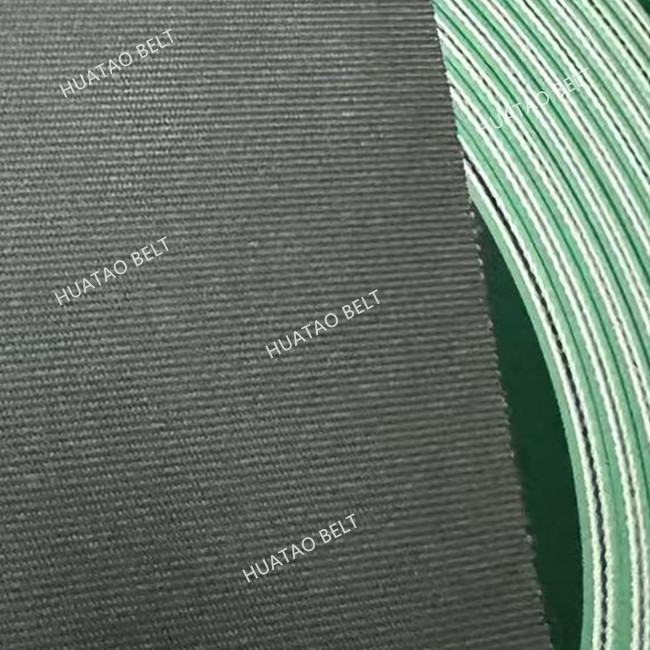
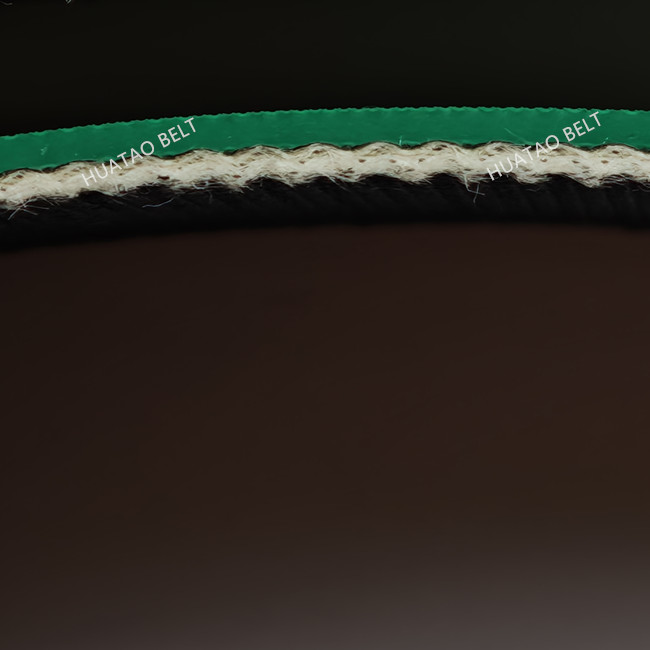
A special-purpose industrial conveyor belt may contain several functional layers:
Conveying-side cover: Provides the required grip, abrasion resistance and contact properties.
Tensile reinforcement: Carries the belt tension and helps control elongation.
Pulley-side cover: Provides suitable contact with the drive and support rollers.
Depending on the application, rubber, polyurethane, polyamide reinforcement or other suitable materials may be considered.
The exact combination should be determined by the conveyor design rather than by material name alone.
| Selection factor | Why it matters |
| Surface friction | Helps prevent board slipping |
| Abrasion resistance | Supports longer operating life |
| Belt thickness | Affects pulley compatibility and transfer height |
| Tensile strength | Must match operating tension |
| Elongation | Influences tracking and tension adjustment |
| Pulley diameter | Determines bending requirements |
| Temperature resistance | Must suit board and surrounding equipment temperatures |
| Antistatic properties | Relevant to the operating environment |
| Joint design | Affects installation and continuous running |
Board slipping: The conveying surface may not provide sufficient grip for the board weight, speed or acceleration conditions.
Surface scratches: Foreign particles, damaged belt surfaces or unsuitable contact materials may cause marks.
Belt wear: Continuous friction, abrasive dust and repeated bending may accelerate wear.
Belt tracking deviation: Misalignment, uneven tension, roller condition or belt dimensional variation may cause tracking problems.
Joint damage: Poor joint design or incorrect installation may reduce the reliability of the endless belt.
Identifying the actual cause before ordering a replacement can help avoid repeating the same problem.
To evaluate a special conveyor belt for your finished board line, please provide:
Application and conveyor position
Belt width and length
Belt thickness
Existing belt material and surface pattern
Pulley diameter and roller arrangement
Operating speed and working tension
Board dimensions and approximate weight
Board surface type and temperature during transfer
Joint type and installation conditions
Photos of the existing belt and conveyor system
A special conveyor belt for finished wood-based panels is not selected by dimensions alone.
Surface friction, abrasion resistance, tensile performance, dimensional stability, antistatic requirements and joint design all need to be considered together.
Providing the actual conveyor information makes it easier to evaluate the appropriate belt construction and replacement specifications.
Contact us with your conveyor dimensions, working conditions and photos to discuss a suitable special conveyor belt for your wood-based panel production line.
Pre-press Belt without Perforated / Pre-press Belt with Perforated / Deaeration Belt with Carbon Fiber / Deaeration Belt with Copper Wire / Forming Belt for Continuous Press Machine / Forming Belt for Multi-Stage Press Machine
can not be empty
can not be empty

HUATAO WOOD PROCESSING BELT Co., Ltd
ADD : No.298 Zhonghua North Street, Shijiazhuang 050000 China.
TEL : +86 0311 80690567
EMAIL :bella@huataogroup.com
Web: www.huataobelt.com
 WhatsApp & WeChat : +86 17731169773