
In the production of particle board, MDF, HDF and other wood-based panels, the pre-pressing stage is an important step between mat forming and final pressing.
After forming, the wood fiber or particle mat is still relatively loose and contains a considerable amount of air. The pre-pressing process compresses the mat, reduces its thickness and improves its structural stability before the material enters the subsequent press.
For production lines equipped with a multilayer press or multi-opening press, the pre-press belt must operate reliably while handling continuous mechanical loading and contact with wood particles and resin.
Among different belt constructions, the 6 mm PVC Pre-Press Belt is a practical solution for specific multilayer-press applications.
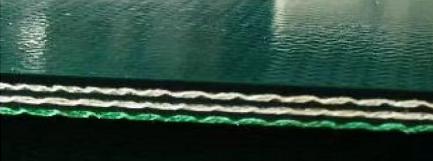
A 6 mm PVC Pre-Press Belt is an industrial belt designed for conveying and pre-compressing wood-based panel mats before the main pressing process.
Compared with thinner forming or conveying belts, the 6 mm construction provides a more substantial belt structure for applications requiring repeated mechanical loading.
Its typical application areas include:
The exact belt construction should be matched with the original machine and operating conditions.
The material leaving the forming section has a relatively low bulk density and contains air between the fibers or particles.
Before final pressing, the mat needs to become sufficiently stable for transportation and further compression.
The pre-pressing process can help:
Reduce Mat Thickness
Remove Entrapped Air
Increase Mat Stability
Improve Material Transfer
Prepare the Mat for Final Pressing
A pre-press system therefore does more than simply transport the material.
It forms an important connection between forming and final pressing.
The main attraction of a 6 mm PVC construction is the combination of belt thickness, structural stability and practical cost for suitable applications.
Compared with a very thin conveyor belt, a 6 mm belt provides a more substantial working structure.
Potential advantages include:
The thicker construction can provide stable support during continuous pre-pressing operation.
The belt is subjected to repeated pressure, bending and tension during operation.
A properly selected PVC surface can provide suitable contact with the material and machine components.
For certain multilayer or multi-opening pre-press applications, PVC belts can provide a cost-effective alternative to more specialized belt constructions.
A standardized thickness such as 6 mm can simplify replacement when the original belt specification is confirmed.
Not every pre-press machine uses the same belt structure.
Depending on the machine, manufacturers may select different materials and reinforcement systems.
For example, specialized pre-press belts can use TPU/PUR and aramid reinforcement, while other constructions use PVC and multi-layer reinforcement. HUATAO's current product information shows both types in its wood-based-panel belt range.
A simplified comparison is:
| Feature | 6 mm PVC Belt | TPU/PUR + Aramid Belt |
|---|---|---|
| Material | PVC | TPU/PUR |
| Reinforcement | Multi-layer construction, depending on specification | Aramid reinforcement |
| Typical positioning | Practical / traditional applications | Higher-performance applications |
| Flexibility | Good, specification dependent | Generally high |
| Pressure resistance | Suitable for specified applications | High |
| Chemical resistance | Good, depending on formulation | Generally very good |
| Cost | Usually more economical | Usually higher |
| Application | Selected multilayer/pre-press systems | Demanding pre-press systems |
This is a general comparison. The correct choice should always follow the original equipment specification.
This is an important point when purchasing replacement belts.
Two belts may both be advertised as 6 mm PVC Pre-Press Belts, but their performance can still be different.
Important factors include:
Therefore, belt thickness alone is not enough to determine compatibility.
A pre-press belt operates under repeated mechanical stress.
During operation, it may experience:
Tension → Compression → Bending → Friction → Repeated Loading
At the same time, wood particles and resin can come into contact with the belt surface.
The belt therefore needs an appropriate combination of:
Surface Material + Fabric + Reinforcement + Joint + Thickness
A properly engineered structure helps the belt maintain stable operation throughout its service period.
For multilayer press systems, pre-pressing is especially important because the mat needs to achieve sufficient stability before subsequent handling and pressing.
A typical process can be represented as:
Particle/Fiber Preparation
↓
Drying & Screening
↓
Glue Application
↓
Mat Forming
↓
Pre-Pressing
↓
Cutting / Transfer
↓
Multilayer Press
↓
Finished Panel
The pre-press belt operates directly within this transition zone.
Its running stability can therefore influence material transfer and overall production continuity.
For suitable multilayer press applications, a 6 mm PVC belt can provide several practical benefits.
PVC belt construction can be an economical option for plants looking to control replacement costs.
With correct tension and tracking, the belt can maintain stable movement.
The surface can be designed to withstand contact with wood particles and the production environment.
PVC belt materials can provide useful resistance to moisture and certain chemicals, although actual compatibility depends on the formulation and resin system.
For existing machines using a standard PVC construction, replacement can be relatively straightforward when dimensions and joint specifications are confirmed.
A pre-press belt may fail before its expected service period for reasons that are not directly related to the belt material.
Common causes include:
Excessive tension can increase mechanical stress.
Insufficient tension can cause slipping and tracking problems.
Misalignment may cause edge wear and unstable belt running.
Damaged, contaminated or misaligned rollers can accelerate belt wear.
Adhesive deposits may change the belt surface and affect operation.
Operating outside the belt's intended mechanical range can shorten service life.
An unsuitable or poorly executed joint can become a weak point.
The joint is one of the most critical parts of a pre-press belt.
A belt can have excellent material properties but still experience premature failure if the joint is unsuitable.
Before ordering a replacement belt, it is important to confirm:
For multilayer press applications, the joint must be compatible with the machine's roller and pressure configuration.
Before purchasing, we recommend confirming the following information:
1. Machine Manufacturer
2. Machine Model
3. Belt Width
4. Belt Length
5. Belt Thickness
6. Belt Structure
7. Surface Pattern
8. Tensile Strength
9. Joint Type
10. Operating Speed
11. Working Temperature
12. Material Being Pressed
This information helps avoid the common mistake of ordering a belt based only on length, width and thickness.
Particle board production uses wood particles that can vary considerably in size and shape.
During forming and pre-pressing, the belt needs to maintain stable contact with the material while supporting compression and transportation.
The 6 mm PVC construction can be considered for suitable particle board pre-press systems where the original machine is designed for this belt type.
The final specification should be confirmed based on the original belt and machine parameters.
MDF production uses much finer wood fibers than particle board.
This creates different requirements for surface behavior, cleaning and material adhesion.
A suitable PVC pre-press belt should therefore be selected according to:
The belt should be matched to the actual MDF pre-press machine rather than selected solely because it is 6 mm thick.
Regular inspection can significantly reduce unexpected belt failures.
Recommended checks include:
Early detection is particularly important because pre-press belt failure can interrupt the material flow before the main pressing process.
HUATAO supplies PVC Pre-Press Belts for wood-based panel machinery, including traditional multi-layer and multilayer press applications.
Our belt solutions can be evaluated according to:
HUATAO's current product range includes PVC/multi-layer pre-press belt constructions as well as TPU/aramid and PU/aramid options, allowing the belt type to be matched more closely to the application.
For a replacement pre-press belt, simply providing the phrase “6 mm PVC belt” may not be enough.
HUATAO can evaluate the application using:
This helps determine whether a standard 6 mm PVC construction or another reinforced belt structure is more appropriate.
The 6 mm PVC Pre-Press Belt is a practical belt solution for suitable multilayer press and pre-press applications in the wood-based panel industry.
Its role is not limited to material transportation. The belt operates within a process where the loose wood-fiber or particle mat is compressed, stabilized and prepared for subsequent pressing.
For this reason, selecting the correct belt requires more than checking thickness.
Material + Reinforcement + Surface + Tensile Strength + Joint + Machine Compatibility
all contribute to the final performance.
For MDF, particle board and other wood-based panel production lines, HUATAO can provide 6 mm PVC Pre-Press Belts and customized belt solutions based on actual machine requirements.
HUATAO Wood-Based Panel Machinery Co., Ltd.
Email: bella@huataogroup.com
WhatsApp / Tel: +86 17731169773
Website: www.woodpanelmachinery.com
For 6 mm PVC Pre-Press Belt, Multilayer Press Belt, Particle Board Pre-Press Belt, MDF Pre-Press Belt and customized wood-based panel conveyor belts, please send us your machine model, belt dimensions, original belt specification, drawings or photographs.
can not be empty
can not be empty

HUATAO WOOD PROCESSING BELT Co., Ltd
ADD : No.298 Zhonghua North Street, Shijiazhuang 050000 China.
TEL : +86 0311 80690567
EMAIL :bella@huataogroup.com
Web: www.huataobelt.com
 WhatsApp & WeChat : +86 17731169773