
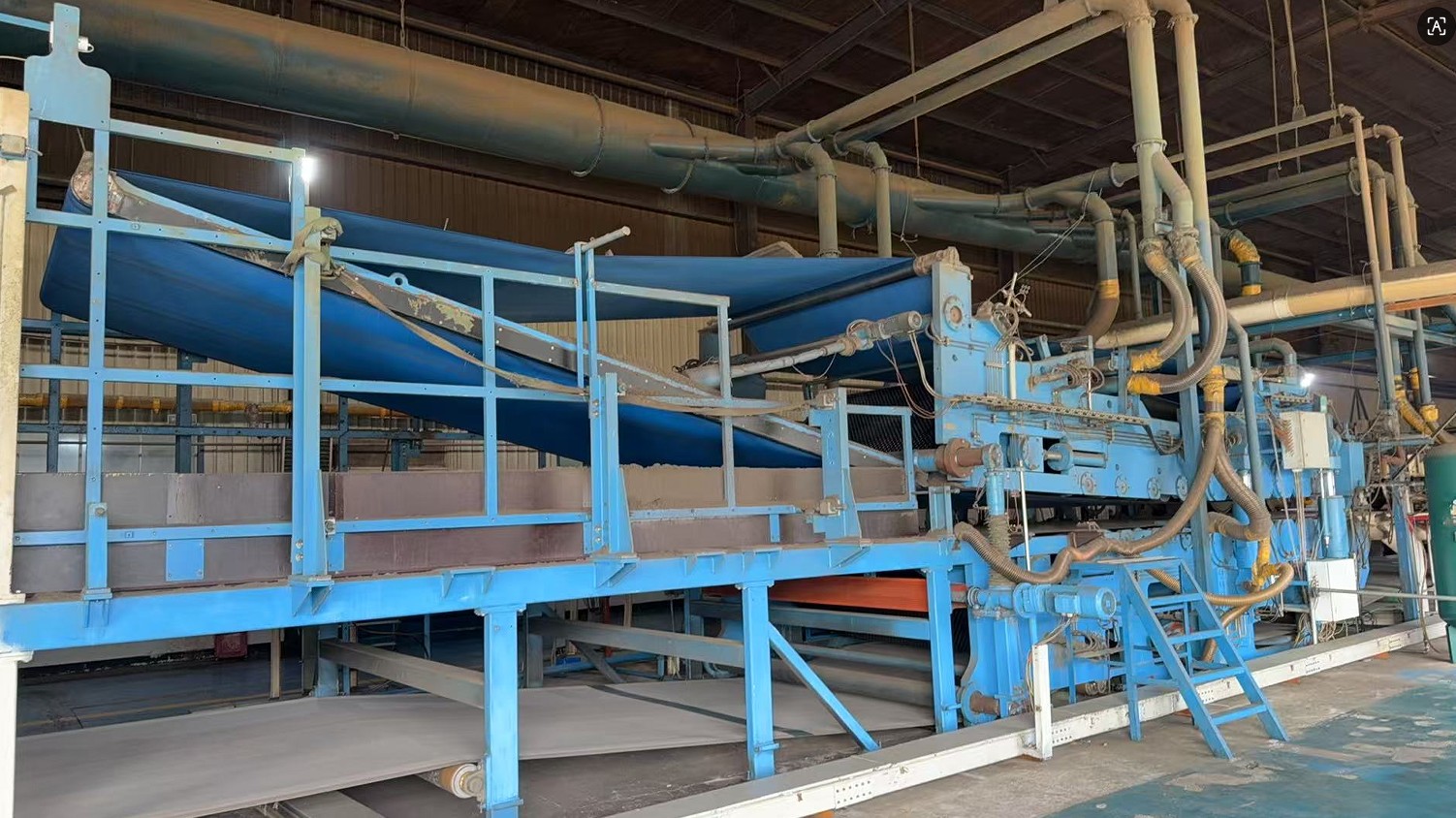
In MDF, HDF, particle board and other wood-based panel production lines, the Deaeration Belt is an important part of the material forming and air-removal process.
During continuous operation, the belt is exposed to wood fibers, fine dust, resin, moisture, friction and repeated mechanical movement.
For some applications, the belt also needs to provide a certain level of electrostatic dissipation or conductive performance.
This is where the belt's internal conductive structure becomes important.
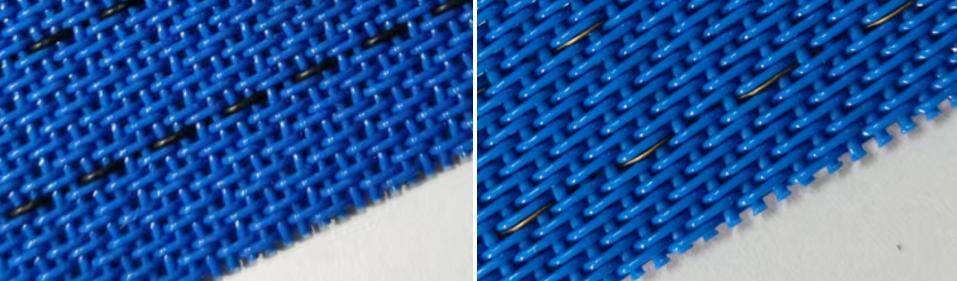
Two common options are:
Carbon Filament
and
Copper Wire
Although both can be incorporated into a Deaeration Belt to provide conductive functionality, they are not identical solutions.
So, what is the difference?
During the transportation and forming of dry wood fibers and particles, friction between materials and belt surfaces can generate static electricity.
If static charge accumulates, it may contribute to:
A conductive structure within the belt can provide a path for dissipating static charge when properly connected to the machine's grounding system.
Therefore, the purpose of adding carbon filament or copper wire is not simply to make the belt “stronger.”
The main consideration is functional conductivity and electrostatic control.
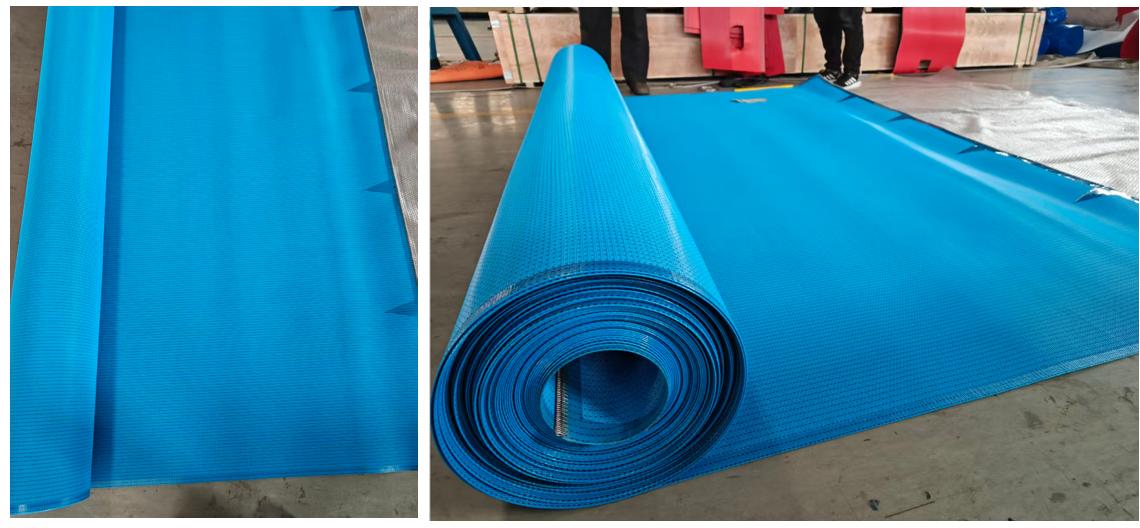
Carbon filament is a conductive material that can be integrated into the belt structure.
Its characteristics make it suitable for applications where conductivity needs to be combined with flexibility and repeated belt movement.
Good Flexibility
Carbon filament can be incorporated into flexible textile structures without creating a rigid metallic reinforcement.
Conductive Function
Depending on the construction and electrical resistance, carbon filament can help dissipate static charge.
Good Compatibility with Textile Structures
Carbon-based conductive elements can be integrated into the belt fabric or conductive layer.
Suitable for Continuous Belt Movement
The flexible nature of the filament can be advantageous where the belt repeatedly bends around rollers.
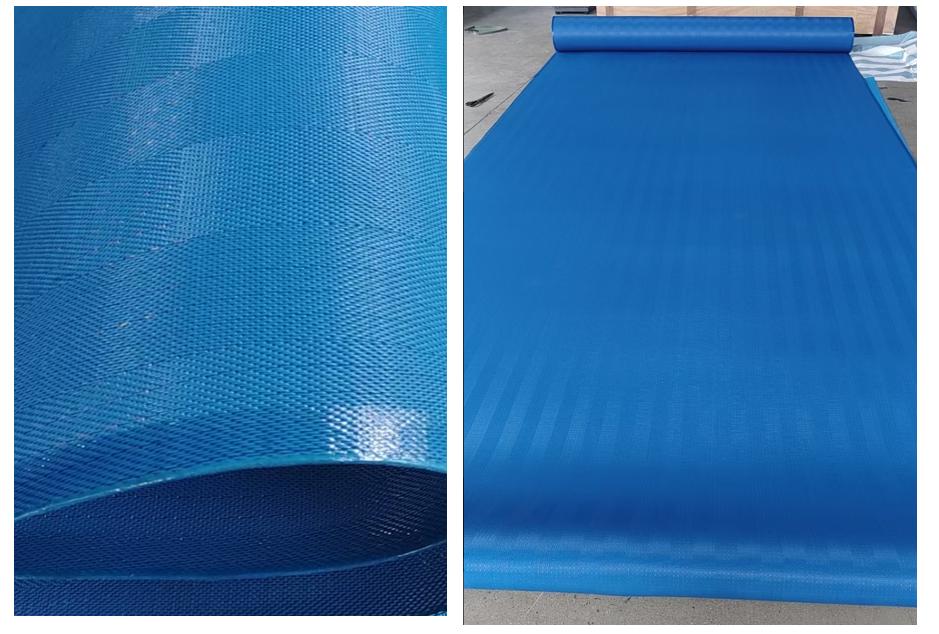
Copper is well known for its excellent electrical conductivity.
Copper wire can be incorporated into a Deaeration Belt when a stronger conductive pathway is required.
Excellent Electrical Conductivity
Copper has very low electrical resistivity, allowing efficient electrical conduction.
Stable Conductive Path
A properly designed copper-wire structure can provide a defined conductive pathway through the belt.
Metallic Reinforcement
Copper wire has different mechanical characteristics from textile-based conductive filaments and therefore requires suitable integration into the belt structure.
Suitable for Specific Conductive Requirements
Copper-wire belts can be considered when the equipment or production environment has specific requirements for conductive performance.
The most important differences can be summarized as follows:
| Feature | Carbon Filament | Copper Wire |
|---|---|---|
| Electrical conductivity | Good, depending on construction | Excellent |
| Flexibility | Generally high | Generally lower than filament |
| Material type | Carbon-based conductive filament | Metal |
| Repeated bending | Generally well suited | Requires appropriate construction |
| Corrosion resistance | Generally high | Can be affected by oxidation/corrosive conditions |
| Weight contribution | Relatively low | Higher |
| Conductive pathway | Distributed / integrated | More defined metallic pathway |
| Application | Static dissipation and flexible belt structures | Strong conductive requirements |
| Cost | Construction dependent | Material and design dependent |
| Belt design | Textile-oriented | Requires suitable wire integration |
Important: The actual performance depends on the complete belt construction, not simply whether carbon filament or copper wire is used.
If we only compare the raw materials:
Copper has significantly higher electrical conductivity than carbon filament.
However, this does not automatically mean that a copper-wire Deaeration Belt is always the better choice.
The electrical performance of a finished belt depends on:
Therefore, the correct comparison should be based on the finished belt's electrical resistance and application requirements, rather than raw-material conductivity alone.
A Deaeration Belt does not remain stationary.
It continuously travels around rollers and other machine components.
Therefore, repeated bending and flexing are important considerations.
Carbon filament is generally more compatible with flexible textile structures.
Copper wire, being metallic, requires careful integration into the belt to prevent problems caused by excessive bending, fatigue or mechanical damage.
This is why copper-wire belts should be designed specifically for the intended application rather than simply inserting copper wire into a conventional belt.
The production environment of wood-based panels can contain:
Copper can be affected by oxidation and certain chemical environments.
Carbon-based conductive materials generally provide strong resistance to corrosion.
However, corrosion resistance depends on the complete belt construction and the actual chemicals present in the production environment.
For applications involving potentially corrosive materials, this factor should be evaluated before selecting the conductive structure.
Not necessarily.
This is another common misunderstanding.
Copper wire primarily provides a conductive function.
It should not automatically be regarded as a replacement for the belt's main tensile reinforcement.
The mechanical strength of a Deaeration Belt is determined by its overall construction, including:
Therefore:
Copper Wire ≠ Automatically Higher Belt Strength
The same principle applies to carbon filament.
For MDF production, the choice depends on the equipment and electrical requirements.
A carbon-filament Deaeration Belt may be suitable when the application emphasizes:
A copper-wire Deaeration Belt may be considered when:
The actual specification should be confirmed according to the original equipment.
Particle board production also involves continuous movement of wood particles and dust.
Both conductive constructions may be suitable depending on the equipment.
The selection should consider:
Machine Model
Belt Dimensions
Operating Speed
Temperature
Material Moisture
Dust Conditions
Resin Characteristics
Required Electrical Resistance
Joint Configuration
There is therefore no universal answer that one material is better for every particle board production line.
A common mistake is to compare only electrical conductivity.
For a Deaeration Belt, the overall performance should be evaluated from several dimensions:
Conductivity
Flexibility
Wear Resistance
Tensile Strength
Dimensional Stability
Joint Quality
Chemical Resistance
Machine Compatibility
This is particularly important for continuous production lines where belt replacement involves considerable downtime and installation work.
When replacing a Deaeration Belt, HUATAO recommends providing:
This information helps determine the appropriate belt construction.
HUATAO supplies Deaeration Belts and other conveyor belts for wood-based panel production lines.
Depending on the application, belt constructions can be evaluated with different conductive solutions, including:
The belt structure can be evaluated according to the original machine, dimensions, operating environment and technical requirements.
HUATAO also supplies related belts for:
When comparing carbon filament and copper wire, the better question is:
Which conductive structure is more suitable for this specific production line?
Carbon filament and copper wire have different characteristics.
The best choice depends on the required conductivity, mechanical flexibility, environmental conditions, belt construction and original machine design.
For industrial production, compatibility is more important than simply choosing the material with the highest conductivity.
The main difference between a carbon-filament Deaeration Belt and a copper-wire Deaeration Belt lies in their conductive structure and material characteristics.
Carbon filament generally offers a flexible, lightweight conductive solution that integrates well with textile belt structures.
Copper wire provides excellent electrical conductivity and can offer a defined conductive pathway when properly incorporated into the belt.
However, neither option should automatically be considered superior.
The final selection should take into account electrical resistance, flexibility, wear resistance, chemical environment, mechanical requirements, joint design and machine compatibility.
For MDF, HDF, particle board and other wood-based panel production lines, choosing the correct Deaeration Belt construction can help maintain reliable operation and effective static control.
HUATAO Wood-Based Panel Machinery Co., Ltd.
Email: bella@huataogroup.com
WhatsApp / Tel: +86 17731169773
Website: www.woodpanelmachinery.com
For Carbon Filament Deaeration Belt, Copper Wire Deaeration Belt, Conductive Deaeration Belt and other wood-based panel conveyor belts, please provide the machine model, belt dimensions, original specification, drawings or photographs.
#HUATAO #DeaerationBelt #CarbonFilamentBelt #CopperWireBelt #ConductiveBelt #ConductiveDeaerationBelt #DeaerationConveyorBelt #MDFDeaerationBelt #ParticleBoardBelt #WoodPanelBelt #MDFProductionLine #ParticleBoardProductionLine #OSBProductionLine #WoodBasedPanelMachinery #WoodProcessingMachinery #FormingBelt #PrePressBelt #IndustrialConveyorBelt #CarbonFilament #CopperWire
can not be empty
can not be empty

HUATAO WOOD PROCESSING BELT Co., Ltd
ADD : No.298 Zhonghua North Street, Shijiazhuang 050000 China.
TEL : +86 0311 80690567
EMAIL :bella@huataogroup.com
Web: www.huataobelt.com
 WhatsApp & WeChat : +86 17731169773